Rechenzeit auf Europas schnellstem Rechner für Vision-Modelle, die ohne teure Labels auskommen
Rechenzeit auf Europas schnellstem Rechner für Vision-Modelle, die ohne teure Labels auskommen

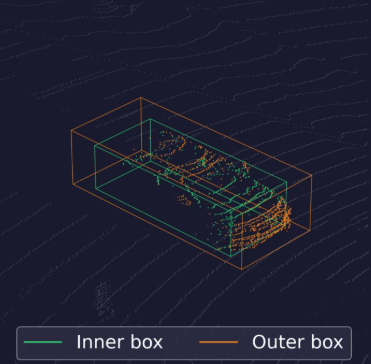
LiDAR-based 3D object detection has gotten remarkably good at finding cars, pedestrians and cyclists on clean benchmark data. But "good on clean data" and "safe on the road" are not the same thing, and the gap between them is exactly where adversarial robustness lives.
In our Industrial Deep Learning (IDL) research area, we asked a deliberately uncomfortable question: do the latest, highest-capacity 3D detectors actually inherit more robustness or just better numbers? We built a holistic robustness framework and put four detectors (PointPillars, CenterPoint, PillarNeSt, FocalFormer3D) through five LiDAR-specific attacks on nuScenes and Waymo.
Three things we learned:
→ mAP is the wrong lens. We decouple structural robustness (point-cloud density, localization) from predictive robustness (misclassification, translation/scale/yaw error, distance from ego). A model can hold its mAP and still produce dangerously misoriented bounding boxes, yaw estimation proved disproportionately fragile, and a wrong heading is what a downstream motion planner acts on.
→ More capacity ≠ more safety. High-capacity, voxel-based detectors were more susceptible to structured coordinate perturbations than simpler pillar-based ones. Recent architectures are about as vulnerable as their predecessors years ago, and the objects that collapse first are the safety-critical ones: pedestrians and cyclists.
→ Even the metric needed fixing. Common ASR reporting inflates results by counting detections already missed on clean data. We propose a stricter ASR that excludes those and counts confidence collapse, not just misclassification.
The takeaway isn't "these models are bad." It's that benchmarks rewarding only clean-data accuracy quietly reward the wrong thing.
Accepted at ECCV2026 (main conference). It's the second LiDAR paper from Adwait Chandorkar in our Visual Perception & Understanding research area, after his Hashtag#ICCV2025 workshop work on efficient detector backbones, first efficiency, now robustness. Co-authored by Adwait Chandorkar, Kai Krink, Yerdana Maulenbay, Dr.-Ing. Hasan Tercan and Tobias Meisen, emerging from the AiThena project.
Industrial AI has to work where it counts, not just on benchmarks. That's the line we hold in the IDL research area at TMDT at Bergische Universität Wuppertal.
Weitere Infos über #UniWuppertal: