Rechenzeit auf Europas schnellstem Rechner für Vision-Modelle, die ohne teure Labels auskommen
Rechenzeit auf Europas schnellstem Rechner für Vision-Modelle, die ohne teure Labels auskommen

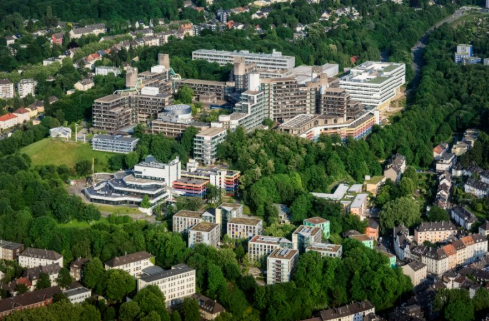
This work marks the second publication arising from the successful academic cooperation between the Department of Mathematical Sciences at Indian Institute of Technology - Banaras Hindu University (IIT-BHU), Varanasi (India) and the School of Mathematics and Natural Sciences at the Bergische Universität Wuppertal (Germany).
What is this research about? Modeling complex interfacial phenomena like corrosion kinetics requires capturing history-dependent transport and memory decay. Traditional integer-order or purely power-law fractional models often struggle to accurately represent these long-term non-local temporal dynamics.
To bridge this gap, we introduce FM-tfPINN (Fractional-Memory Physics-Informed Neural Network), a novel, mesh-free deep learning paradigm designed for both forward simulation and inverse parameter identification in tempered time-fractional coupled phase-field systems.
Key Contributions & Innovations:
- Direct Memory Integration: Unlike conventional PINNs that enforce history constraints solely through the residual loss, our framework embeds tempered fractional memory directly into the neural representation using latent memory-source functions.
- Fast History Compression: We developed a shifted residual formulation utilizing graded temporal meshes and sum-of-exponentials (SOE) approximation (like for discrete artificial boundary conditions) to efficiently evaluate non-local operators without full history summation.
- Interface-Aware Learning: By deploying residual-adaptive collocation strategies, training is dynamically focused on thin moving diffuse interface regions and high-gradient zones.
- Unified Inverse Capability: The framework successfully recovers hidden kinetic parameters and missing transport mobilities using only sparse physical corrosion observations (like pit geometry and corrosion depth) rather than dense snapshots.
Congratulations to my brilliant co-authors who made this joint venture possible: Shubham Kumar, Himanshu Kumar Dwivedi, and Rajeev!
Read the full preprint here to dive deep into the math and machine learning framework: A Fractional-Memory Physics-Informed Neural Network with Fast History Compression for Tempered Fractional Coupled Phase-Field Systems
Weitere Infos über #UniWuppertal: